To see all the articles in full click here for the Wiley Online Library
Contents of Vol. 29, no. 1-4 2006
Vol. 29, no. 4, October 2006
- Is there a viable petroleum system in the Carson and Salar Basins, offshore Newfoundland?
J.B.W. Wielens (Geological Survey of Canada Atlantic), C. D. Jauer and G. L. Williams view abstract - Higher plant biomarkers in Paleogene crude oils from the Yufutsu oil- and gasfield and offshore wildcats, Japan
S. Yessalina (Hokkaido University), N. Suzuki, H. Nishita and A. Waseda view abstract - Petroleum potential, thermal maturity and the oil window of oil shales and coals in Cenozoic rift-basins,
central and northern Thailand
H. I. Petersen (GEUS Denmark), A. Foopatthanakamol and B. Ratanasthien view abstract - Organic-inorganic interactions in oilfield sandstones: Examples from turbidite reservoirs in the Campos Basin,
offshore Eastern Brazil
E. A. Prochnow (Universidade Federal do Rio Grande do Sul, Brazil) et al. view abstract - The origin of dolomite in the Asmari Formation (Oligocene - Lower Miocene), Dezful Embayment, SW Iran
A.A.M. Aqrawi (Statoil) et al. view abstract - Obituary: G. D. Hobson
- Index, 2006
- International Events
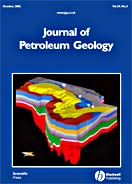
- Cover: The cover figure illustrates a digital model of the Carson Basin, offshore Newfoundland (eastern Canada) and shows a significant moment in the basin's geological history: the reservoir rock (in yellow: sandstones of the Jeanne d'Arc Formation) has been deposited on top of the source rock (brown: shales of the Egret Member). Legend: red - basement; orange - sand/siltstone; green - salt; purple - dolomite; grey - shale; blue - limestone. The orange tip of the grey compass points north. Black crosses are well locations: B: Bonnition H-32; O: Osprey H-84; S: Skua E-41; G: St. George J-55. See the related paper by Wielens et al
Vol. 29, no. 3, July 2006

- Exploring for fan and delta sandstones in the offshore Falklands Basins
P. Richards (BGS) et al. view abstract - Cylindrical and conical fold geometries in the Cantarell structure, Southern Gulf of Mexico: Implications for hydrocarbon
exploration
J. J. Mandujano V. (Inst. Mexicano del Petroleo) and J. D. Keppie M. view abstract - Petroleum migration, faults and overpressure, Part I: calibrating basin modelling using petroleum in traps - a review
D. A. Karlsen and J. E. Skeie (University of Oslo) view abstract - Mineralogical, pore and petrophysical characteristics of the Devonian Jauf Sandstone reservoir, Hawiyah field,
Eastern Saudi Arabia
S. Saner et al. (King Fahd University of Petroleum and Minerals) view abstract - Predicting the timing and characteristics of petroleum formation using tar mats and petroleum asphaltenes: A case study
from the Northern North Sea
M. Keym and V. Dieckmann (GeoForschungsZentrum, Potsdam) view abstract - Book review
- International Events
- Cover: Diagrams illustrate a two-stage model of fault-block filling with petroleum migration across a fault. Stage 1: a petroleum column builds up in carrier sands near the fault zone, and oil is injected into the fault and moves upwards due to buoyancy forces. Petroleum migrates into the first hydrostatic reservoir encountered (i.e. the deepest reservoir strata) until equilibrium is established between the oil in the fault zone and that in the reservoir. Quartz cementation may partly seal the fault zone during progressive burial. Stage 2: continued burial results in source rock maturation and renewed oil expulsion, and another oil charge builds up in the migration avenue. As in stage 1, this oil moves upwards in the fault zone until it meets a hydrostatic reservoir unit -- in this case, a shallower unit than in stage 1. The result is that the reservoir fills from the bottom up, with individual reservoir units containing petroleum of varying maturity, GOR and API. See the related paper by Karlsen and Skeie
Volume 29, no. 2, April 2006
- Source-rock evaluation and basin modelling in NE Egypt (NE Nile Delta and Northern Sinai)
F. Shaaban (Mansoura University, Egypt), R. Lutz, R. Littke, C. Bueker and K. Odisho view abstract - Analysis of reserves discovered in petroleum exploration
D. G. Quirk (Maersk Oil and Gas) and R. Ruthrauff view abstract - Obtaining fracture information for low-permeability (tight) gas sandstones from sidewall cores
S. E. Laubach (University of Texas) and J. F. W. Gale view abstract - Seismic facies analysis based on 3D multi-attribute volume classification, Dariyan Formation, SE Persian Gulf
P. Farzadi (University of Bergen, Norway) view abstract - Biomarker geochemistry of crude oils from the Qaidam Basin, NW China
by Yi Duan (Lanzhou Institute of Geology, China) et al. view abstract - Possible correlations between crude oil chemical composition and reservoir age
Y. M. Polichtchouk (Institute of Petroleum Chemistry, Tomsk, Russia) and I. G. Yashchenko view abstract - International Events
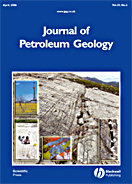
- Cover: Background photograph shows a fracture swarm in Cambrian sandstones in NW Scotland. Top left: coring underway at a rig in West Texas. Lower left: measurement of fracture size distributions along a line of observation in an outcrop of the Cambrian Eriboll Sandstones (NW Scotland) which is an analogue for a tight gas sandstone reservoir. Middle: open fracture in Jurassic La Boca Formation sandstones, NE Mexico (SEM cathodoluminescence image showing fracture porosity (green) and quartz bridges (blue); scale bar is 200 ?m). Lower right: quartz bridges (white) and fracture porosity (dark) at core scale (La Boca Formation, NE Mexico); fracture aperture is about 2.5 mm. Photos by Steve Laubach, Leonel Gomez and Rob Reed. See the related paper by Laubach and Gale
Vol.29, no. 1, January 2006
- Depositional environments, organic maturity and petroleum potential
of the Cretaceous coal-bearing Atane Formation at Qullissat, Nuussuaq Basin,
West Greenland
by G. K. Pedersen (University of Copenhagen), L. A. Andersen, E. B. Lundsteen, H. I. Petersen, J. A. Bojesen-Koefoed and H. P. Nytoft view abstract - Hydrothermally fluoritized Ordovician carbonates as reservoir rocks
in the Tazhong area, Central Tarim Basin, NW China
by Zhijun Jin (SINOPEC, China), Dongya Zhu, Xuefeng Zhang,
Wenxuan Hu and Yucai Song view abstract - Porosity destruction in carbonate platforms
by S. N. Ehrenberg (Statoil, Norway & UAE University) view abstract - The Paleocene sandy Siri Fairway: An efficient "pipeline"
draining the prolific Central Graben?
by S. E.Ohm (University of Oslo/ConocoPhillips, Norway), D. A. Karlsen, A. Roberts, E. Johannessen and O. Høiland view abstract - Quantitative assessment of regional siliciclastic top-seal potential:
a new application of proven technology in the Pelotas Basin, Offshore Brazil
by J. A. Deckelman, S. Lou, P. S. D'onfro and R. W. Lahann (ConocoPhillips, USA) view abstract - International Events
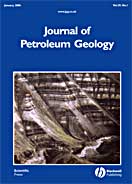
- Cover: Cliff exposures of the deltaic and shallow-marine Atane Formation
(Cretaceous) on the coast of Nuussuaq peninsula, ca. 25km north of Qullissat,
Western Greenland.
Dark-coloured strata are thin humic coals and coaly mudstones which are the subject of the paper by Pedersen et al. on pp. 3-26 of this issue. The exposed section is around 120m thick
Sign up to receive free email alerts containing the Table of Contents for the Journal of Petroleum Geology
Sample Issues
The January 2023 issue (vol 46,1) is available as free-to-read at the Wiley Online Library.
Please click here for more details