To see all the articles in full click here for the Wiley Online Library
Contents of Vol. 33, 2010
Vol. 33, no. 4, October 2010
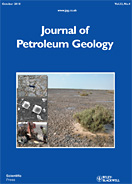
- Microbial dolomites from carbonate-evaporite sediments of the coastal sabkha of Abu Dhabi and their exploration implications
F. N. Sadooni (Qatar University), F. Howari and A. El-Saiy view abstract - Organic geochemistry, burial history and hydrocarbon generation modelling of the Upper Jurassic Madbi Formation,
Masila Basin, Yemen.
Mohammed H. Hakimi (University of Malaya) et al. view abstract - Relationship between organic matter, sulphur and phosphate contents in Upper Cretaceous marine carbonates (Karabogaz
Formation, SE Turkey): implications for early oil generation
S. Inan (TÜBITAK Marmara Research Centre, Turkey) et al. view abstract - Hydrocarbon potential of the Late Cretaceous Gongila and Fika Formations, Bornu (Chad) Basin, NE Nigeria
B. Alalade and R. V. Tyson (University of Newcastle) view abstract - Source rock potential and organic geochemistry of Cenomanian-Turonian black shales, Western Taurus, SW Turkey
R. Kara-Gülbay (Karadeniz University, Turkey) et al. view abstract - Depositional environments and sequence stratigraphy of the Early Triassic Kangan Formation in the northern part of
the Persian Gulf: Implications for reservoir characteristics
M. Peyravi (Islamic Azad University, Tehran), M. R. Kamali and M. Kalani view abstract - Sequence stratigraphy and reservoir characteristics of the Turonian-Coniacian Khasib Formation in Central Iraq
B. Al-Qayim (Sulaimaniah University, Iraq) view abstract - Book Review: The Petroleum Geology of Iraq
- Index, volume 33, 2010
- International Events
- Cover: Main photograph shows tidal flats of the coastal sabkha of Abu Dhabi, covered with a dark-coloured microbial mat several cms thick. These Recent sabkha sediments, including dolomite, are the focus of the paper by Sadooni et al. on pp. 289-298. Dolomite formation is suggested to be mediated by microbial activity in "micro-niches" or small, isolated pore spaces. Inset boxes show a close-up of the sun-desiccated microbial mat; SEM image of dolomite rhombs; and core retrieval operations.
vol. 33, no. 2 July 2010
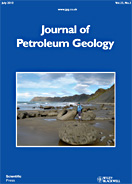
- Tubular concretions in New Zealand petroliferous basins: Lipid biomarker evidence for mineralisation around proposed Miocene
hydrocarbon seep conduits
M. J. Pearson (University of Aberdeen) et al. view abstract - Reservoir sandstones of the Cretaceous Napo Formation U and T Members in the Oriente Basin, Ecuador: Links between
diagenesis and sequence stratigraphy
J. Estupiñan (University of Cadiz), R. Marfil, M. Scherer and A. Permanyer view abstract - Strontium isotope dating of spiculitic Permian strata from Spitsbergen outcrops and Barents Sea well-cores
S. N. Ehrenberg (Statoil), J. M. McArthur and M. F. Thirlwall view abstract - Main factors controlling the compositional variability of seepage oils from Trujillo State, western Venezuela
F Galarraga (Universidad Central de Venezuela) et al. view abstract - Distribution of petrophysical parameters in the Cambro-Ordovician Dibsiyah Member of the Wajid Sandstone, SW Saudi Arabia
I. T. Abdulkadir (KFUPM, Dhahran), A. Sahin and O. M. Abdullatif view abstract - International Events
- Cover: Large tubular carbonate (dolomitic) concretions litter the shore platform south of Whangaehu Beach, eastern North Island, New Zealand. The concretions have eroded out of slope mudstones of the upper Miocene Whangaehu Formation which forms the platform and which is well exposed, together with in situ concretions, in the cliffs which stretch southwards towards Cape Turnagain. Most of the concretions support near-central conduits which are suggested to have focused the upward escape of hydrocarbon gases in a palaeo-cold seep system. See the related paper by Pearson et al. on pp 205 - 220 of this issue. Photo provided by the University of Waikato Cold Seep Research Group.
vol. 33, no. 2, April 2010
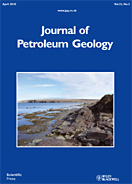
- The Devonian succession in northern Novaya Zemlya, Arctic Russia: sedimentology, palaeogeography and hydrocarbon
occurrence
Li Guo (CASP, University of Cambridge), R. Schekoldin and R. Scott view abstract - Crude oil biodegradation and environmental factors at the Riutort oil shale mine, SE Pyrenees
A. Permanyer (University of Barcelona), J.R.Gallego, M.A. Caja and D. Dessort view abstract - An aeolianite in the Upper Dalan Member (Khuff Formation), South Pars field, Iran
G. Frébourg (University of Geneva), E. Davaud, J. Gaillot, A. Virgone and M. Kamali view abstract - Oil-prone Lower Carboniferous coals in the Norwegian Barents Sea: Implications for a Palaeozoic petroleum system
J.H. van Koeverden (University of Oslo), D. A. Karlsen, L. Schwark, A. Chpitsglouz and K. Backer-Owe view abstract - Hydrocarbon-induced diagenetic dolomite and pyrite formation associated with the Hormoz Island salt dome, offshore
Iran
F. Ghazban (University of Tehran) and I. S. Al-Aasm view abstract - International Events
- Cover: Outcrop photograph shows Early Devonian sandstones exposed in the Russian Harbour region on the Barents Sea (western) coastline of the northern Novaya Zemlya archipelago, Arctic Russia. Solid bitumen occurs in joints and fractures in Devonian carbonates in northern Novaya Zemlya. See the related paper by Guo et al. on pp. 105-122 of this issue. Photograph by Robert Scott (courtesy of CASP, University of Cambridge).
Vol. 33, no. 1, January 2010
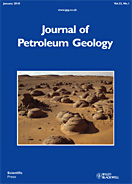
- Diagenetic evolution of incised channel sandstones: Implications for reservoir characterisation of the
Lower Carboniferous Marar Formation, Ghadames Basin, Western Libya
S. Fröhlich (NARG, University of Manchester) et al. view abstract - Variations in composition, petroleum potential and kinetics of Ordovician - Miocene Type I and Type I-II source
rocks (oil shales): implications for hydrocarbon generation characteristics
H. I. Petersen, J.A. Bojesen-Koefoed and A. Mathiesen (GEUS, Denmark) view abstract - Dolomitization and anhydrite precipitation in Permo-Triassic carbonates at the South Pars gasfield, offshore Iran: Controls
on reservoir quality
H. Rahimpour-Bonab (University of Tehran), B. Esrafili-Dizaji and V. Tavakoli view abstract - Petrography and diagenetic characteristics of the upper Oligocene - lower Miocene Ghar Formation in SE Iraq
A. I. Al-Juboury (Mosul University), J. S. Al-Ghrear and M. A. Al-Rubaii view abstract - Source rock potential of Eocene, Paleocene and Jurassic deposits in the subsurface of the Potwar Basin, Northern Pakistan
T. Fazeelat (University of Engineering and Technology, Lahore), M. I. Jalees and T. S. Bianchi view abstract - Erratum
- International Events
- Cover: Cover image shows giant cannonball concretions in the Lower Carboniferous Marar Formation, Tinedhan Anticline, Western Libya. These calcite concretions formed within fluvial sandstones and grew during shallow burial. The Marar sandstones are potential reservoir rocks in the Ghadames Basin, and understanding the distribution of cements, which reduces the overall pore volume, is a critcal factor. See the related paper by Fröhlich et al. on pp. 3-18 of this issue. (Photograph by Sebastian Fröhlich, North Africa Research Group, University of Manchester).
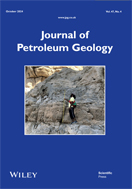
Sign up to receive free email alerts containing the Table of Contents for the Journal of Petroleum Geology
Sample Issues
The January 2023 issue (vol 46,1) is available as free-to-read at the Wiley Online Library.
Please click here for more details